News Details
Health Ingredients • OEM & ODM • Reliable Quality
Health Ingredients • OEM & ODM • Reliable Quality
Ginsenosides, also known as ginseng saponins, belong to a unique class of triterpenoid saponins. They are mainly found in plants of the Panax genus.
As signature marker compounds, ginsenosides help buyers tell authentic ginseng apart from other adaptogenic herbs. They are also the core quality standard for bulk ginseng extract within the nutraceutical supply chain. So far, more than 150 ginsenoside monomers have been isolated and identified from ginseng roots, leaves and berries.
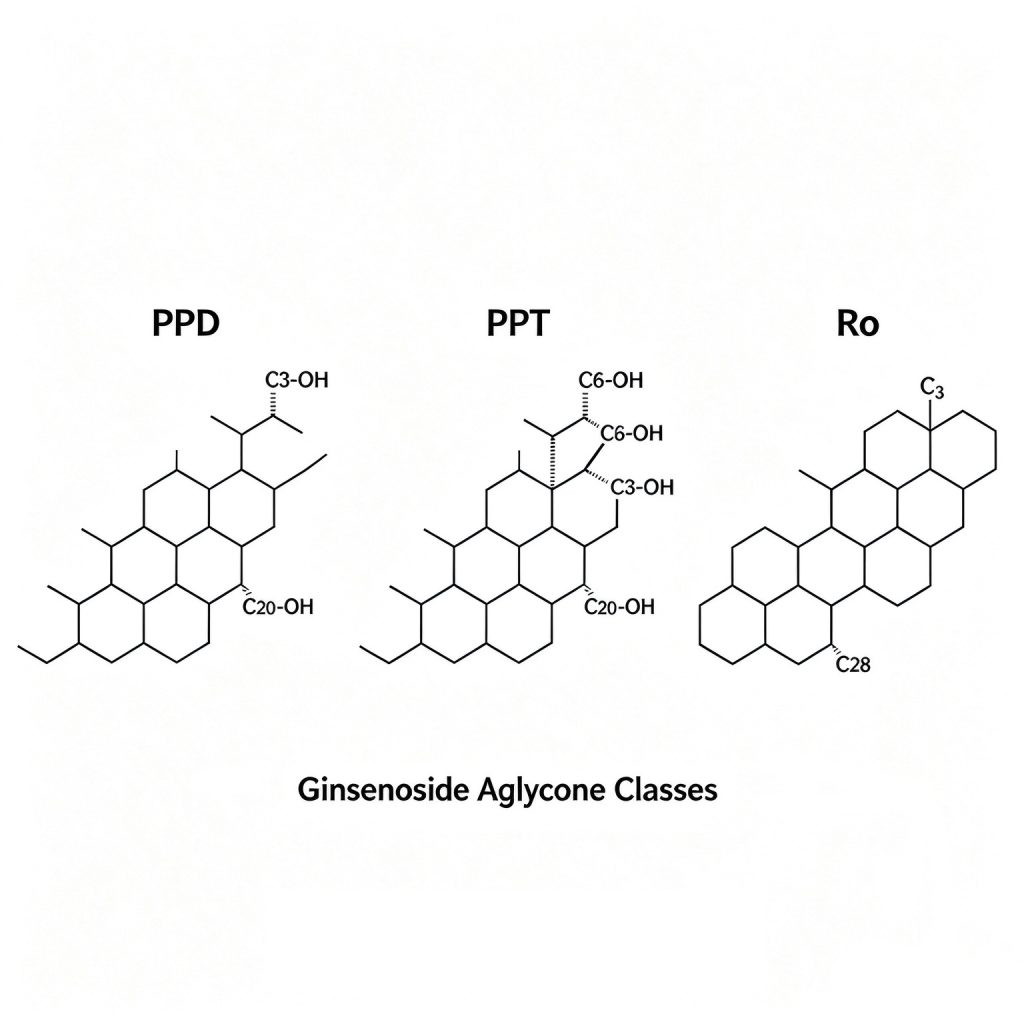
Ginsenosides are grouped by their aglycone skeletons. Most belong to the dammarane type, split into PPD and PPT subgroups. A small portion falls into the oleanane-type category.
| Category | Skeleton Type | Representative Monomers | Sugar Attachment Position |
|---|---|---|---|
| Protopanaxadiol (PPD) | Dammarane-type (tetracyclic triterpene) | Rb1, Rb2, Rc, Rd, Rg3, Rh2, Compound K (CK) | C3 and C20 |
| Protopanaxatriol (PPT) | Dammarane-type (tetracyclic triterpene) | Rg1, Re, Rf, Rg2, Rh1 | C6 and C20 |
| Oleanane-type | Oleanane-type (pentacyclic triterpene) | Ginsenoside Ro | Distinct skeleton, excluded from standard total ginsenoside calculation |
Air-dried white ginseng naturally contains abundant primary ginsenosides, such as Rb1, Rb2, Rc, Rd, Rg1 and Re. Rare ginsenosides including Rg3, Rh2, Rg5 and Rk1 exist only in low amounts in fresh or raw dried ginseng.
These rare ginsenosides form when sugar chains of primary ginsenosides break down via hydrolysis. This reaction happens during high-temperature steaming, the classic process for making red ginseng. After deglycosylation, rare ginsenosides show different metabolic behaviors and bioavailability compared with native ginsenosides.
Total ginsenosides is the widely accepted marker to standardize commercial ginseng extract for B2B buyers. Common specifications sold globally are 5%, 10% and 20% total ginsenosides.
HPLC is the mainstream testing method. It can measure both total ginsenoside content and the distribution of individual monomers.
The total ginsenoside value shows the basic potency level of raw material. Even so, the monomer profile delivers more practical information for formulation development. Two batches with the same total ginsenoside content may perform differently if their PPD and PPT ratios vary greatly.
Trusted suppliers provide full HPLC monomer profiles in COA documents, instead of only a single total number. Consistent ginsenoside profiles across batches are critical. This stability keeps finished capsules, tablets, blended powders and functional beverages uniform.
Many factors affect ginsenoside concentration and monomer ratios. Mature ginseng roots grown for multiple years accumulate far more ginsenosides than young roots.
Cool mountain habitats with large day-night temperature differences support ginsenoside biosynthesis. Soil composition, altitude and rainfall also shape the final compound profile. Harvest time changes the balance between PPD and PPT ginsenosides.
Roots, stems, leaves and berries all have unique ginsenoside patterns. Ginseng root is the preferred feedstock for most commercial extract production. Post-harvest processing creates further changes. Air-drying preserves original primary ginsenosides. Steaming triggers conversion into rare ginsenosides. Fermentation can produce Compound K, a gut metabolite of PPD-type ginsenosides.
New buyers often confuse Panax ginseng with Eleutherococcus senticosus, commonly called Siberian ginseng. It comes from a different genus and contains no ginsenosides. Its key active compounds are eleutherosides. It cannot replace true Panax ginseng in formulas designed around ginsenosides.
Native glycosylated ginsenosides have low oral absorption. After ingestion, gut microbiota cut off sugar chains and form smaller metabolites like Compound K. These metabolites are easier for the human body to absorb. This metabolic feature is an important consideration for product developers selecting ginseng raw materials.
Do not judge raw material quality based only on total ginsenoside percentage. Buyers should review the full HPLC monomer breakdown, heavy metal limits, residual solvent and microbial indicators listed on the COA. Matching the PPD/PPT ratio to your target finished product helps you maintain stable, predictable results.
[Request a COA / Quote] (https://www.thsway.com/contact-us/)
[View Ginseng Extract Product Page](Ginseng Extract | Ginsenosides 80%)