News Details
Health Ingredients • OEM & ODM • Reliable Quality
Health Ingredients • OEM & ODM • Reliable Quality
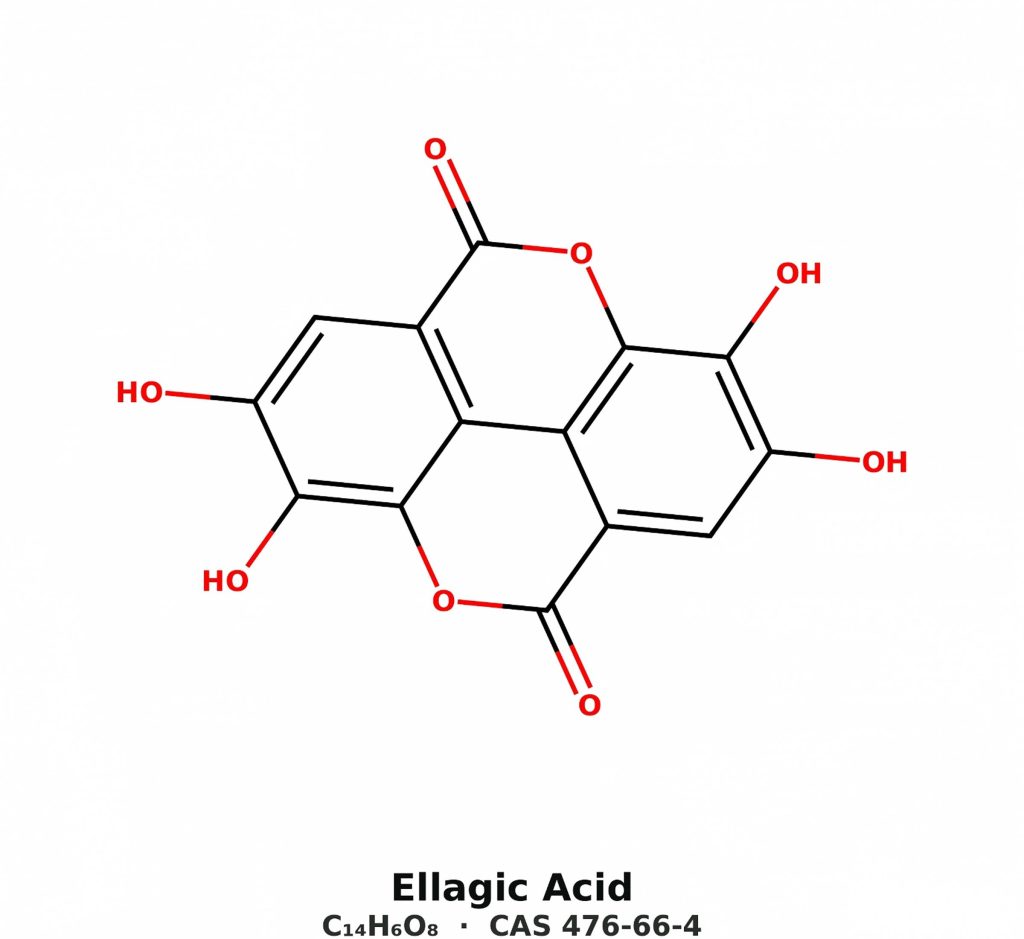
When buyers compare pomegranate extract quotes, ellagic acid is usually one of the first markers listed on the Certificate of Analysis. Understanding what this compound is — and what it does and does not tell you about a batch — makes specification comparison faster, safer and less dependent on supplier claims.
Ellagic acid is a naturally occurring polyphenolic compound found across many fruits, nuts and herbs. Its key identifiers: CAS 476-66-4, molecular formula C₁₄H₆O₈, molecular weight 302.19 g/mol. In pure form it appears as cream-colored needles or a yellow powder with low water solubility. On extract specifications, ellagic acid content is typically expressed as a percentage marker determined by HPLC testing.
Ellagic acid occurs widely in plant foods — pomegranate, raspberries, strawberries, blackberries, grapes, walnuts, pecans and acorns are among the documented sources. In pomegranate specifically, the peel carries far higher polyphenol levels than the edible flesh. This is why commercial pomegranate extract is mostly produced from dried peel rather than whole fruit.
In plants, ellagic acid exists either in free form or bound inside larger molecules called ellagitannins. During extraction and processing, ellagitannins can break down and release free ellagic acid. This distinction directly affects sourcing: peel-based material is rich in ellagitannins, seed material brings punicic acid into the profile, and blended material sits somewhere in between. A specification that simply says “pomegranate extract” without clarifying the raw-material source leaves the marker ratio open to interpretation.